

The building, which operated for more than four decades before closing in 2019, is currently listed as “available for immediate occupancy,” a phrase officials acknowledged has generated several additional questions.
“What does immediate mean?” asked one prospect during a recent tour.
Economic Development Director Megan Calloway reportedly paused.
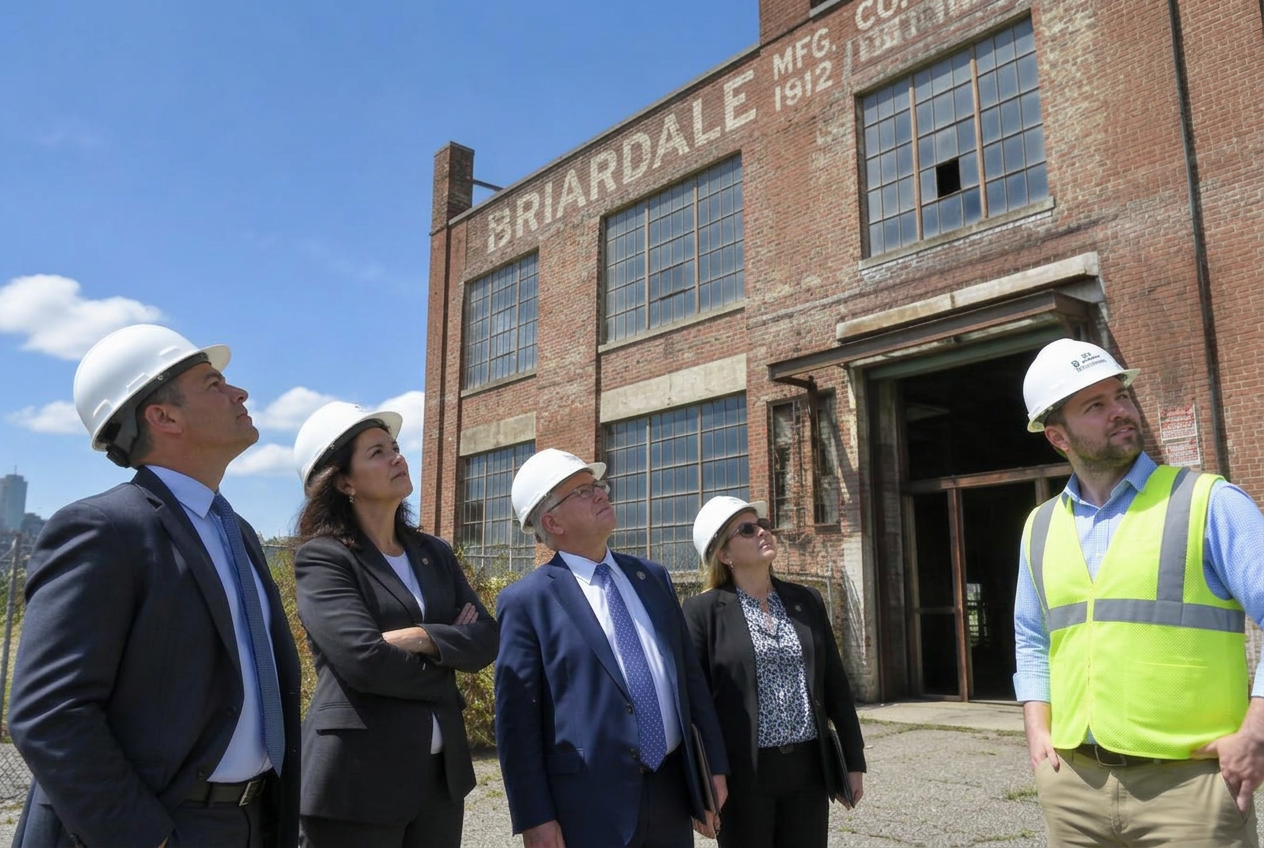
“From a calendar standpoint?”
The prospect then asked whether the building had three-phase power.
“Yes,” Calloway said.
“How much?”
“That’s being confirmed.”
“What voltage?”
“Also being confirmed.”
“What’s the current service capacity?”
“We have a call with the utility Thursday.”
Within seven minutes, the building had reportedly generated 14 new questions and answered three of them.
“It’s extremely productive,” Calloway said.
The former plant sits on 31 acres and includes manufacturing space, offices, loading docks, cranes, compressed air lines and what marketing materials describe as “significant existing infrastructure.”
Exactly how much of that infrastructure still works remains an active area of research.
“There are cranes,” said property representative Kevin Dorsey.
Asked about their tonnage, Dorsey looked upward.
“Large.”
Asked when they were last inspected, he became considerably less specific.
Officials said many questions arise because the building has passed through several owners and operators over the years, each making modifications that were documented with varying degrees of enthusiasm.
One electrical panel is clearly labeled.
Another is labeled “LINE 4.”
There is no longer a Line 4.
A third has a handwritten note that says “DO NOT TURN OFF,” though no one currently knows why.
“We are respecting that note,” Calloway said.
The building’s original plans are believed to exist, although staff have located three separate sets bearing different dates.
One appears to show an addition that was never constructed.
Another does not show an addition that definitely was.
The third set was found rolled up in a maintenance room behind a pallet of ceiling tiles.
“That one may actually be the best one,” Dorsey said.
Prospects have also asked about roof age, clear height, sprinkler capacity, floor thickness, environmental history, dock dimensions, heating systems, wastewater capacity and whether the mysterious locked room near the northwest corner is included in the sale.
“We’re still working on the room,” Calloway said.
The owner reportedly does not have the key.
A former employee might.
Economic development officials say the building remains highly marketable because of its size, location and redevelopment potential.
“It has great bones,” said County Commissioner Steven Holt, using the traditional real estate phrase indicating that nearly everything else may require further investigation.
Holt said the structure offers tremendous opportunity for the right company.
“You’re not starting from scratch,” he said. “You’re starting from somewhere.”
That somewhere continues to evolve.
During a recent engineering inspection, consultants discovered a mezzanine that was not included in the property listing.
“That was actually good news,” Calloway said.
They also discovered two underground tanks that were.
“That was less good.”
Environmental consultants are now reviewing historical records to determine whether the tanks were ever used and, if so, what they contained.
A former plant manager reportedly remembers one of them.
“He thinks it was water,” Dorsey said.
When asked how confident the former manager was, Dorsey replied, “He definitely remembers water being somewhere.”
Site selectors say this level of uncertainty is not unusual with older industrial buildings.
“You walk into a 40-year-old manufacturing plant, you’re going to have questions,” said location consultant Rachel Monroe. “The problem is every answer usually creates two more.”
Monroe recently toured the Briardale facility for a client.
She asked whether the rail spur was active.
“Yes,” Calloway said.
“Currently active?”
“No.”
“Could it be reactivated?”
“Potentially.”
“What would that require?”
“We’re scheduling a meeting with the railroad.”
Monroe nodded.
“That’s usually how this goes.”
Community officials have since assembled a shared spreadsheet containing all outstanding property questions.
The document originally had 26 rows.
It now has 94.
Staff members have added categories including Utilities, Building Systems, Environmental, Transportation, Structural, Ownership and “Things We Didn’t Know We Needed to Ask.”
The spreadsheet also contains a column labeled “Answer,” though officials acknowledged much of that column currently consists of phrases such as “checking,” “awaiting response,” “engineer reviewing” and “ask previous owner.”
Still, Calloway remains enthusiastic about the property.
“This is why due diligence matters,” she said. “Every question we answer makes the building easier to market.”
She then received a text message from an engineer asking whether anyone knew the age of the boiler.
Calloway stared at her phone.
“Apparently we have a boiler.”
At press time, the former manufacturing facility had generated six additional questions, including one from economic development staff asking whether the building actually contains 168,000 square feet.
That figure is now being confirmed.