
The revised labor shed now contains approximately 247,000 workers, up from the 147,000 previously cited in recruitment materials. Officials said the increase reflects a more accurate understanding of how far people may theoretically be willing to drive for the right job.
“We used to think of our labor shed as roughly 45 minutes,” said Cedar Bluff Economic Development Director Wade Mercer. “But when you really look at the region, there’s no reason someone couldn’t drive 62 minutes. Or 71. Maybe 83, depending on traffic.”
The changes were made after a site selector asked how many workers were available for a manufacturing project expected to employ 650 people. According to people familiar with the conversation, the initial answer created what one participant described as “a brief period of unnecessary realism.”

The community’s previous workforce analysis identified approximately 54,000 workers within a 30-minute drive and 147,000 within 45 minutes. Officials said those numbers were strong but became less compelling after the prospect mentioned that several competing locations were reporting labor sheds exceeding 200,000.
Staff immediately began examining alternative commute patterns.
“When you put the map on the screen and start adding rings, it gets encouraging pretty quickly,” Mercer said. “There are a lot of people out there.”
The new analysis includes residents of neighboring counties who already commute into the region, residents who commute somewhere else but could conceivably change jobs, residents who are not currently commuting but own vehicles, and several thousand people whose precise employment status was described in the presentation as “workforce adjacent.”
Officials also added approximately 18,000 college students to the potential labor pool after determining that many of them will eventually graduate.
“We’re not saying they’re all available right now,” Mercer said. “We’re saying they exist.”
The revised map was presented to the prospect last week and reportedly performed well. Where the previous version showed Cedar Bluff surrounded by a relatively modest circle, the new graphic extended significantly farther in every direction and featured several large population centers that had not previously been considered part of the local economy.
One of them is 76 miles away.
Mercer said distance should not necessarily be viewed as a barrier.
“People commute,” he said. “Especially for a good opportunity.”
When asked how many Cedar Bluff residents currently commute 76 miles each way for work, Mercer said the economic development office had not specifically studied that question. He added that the new company would offer competitive wages.
The prospect has not yet disclosed the wages.
Cedar Bluff officials said the expanded labor shed is only one part of a broader workforce strategy that also includes partnerships with local schools, customized training, career awareness programs and continued use of the phrase “talent pipeline” in meetings.
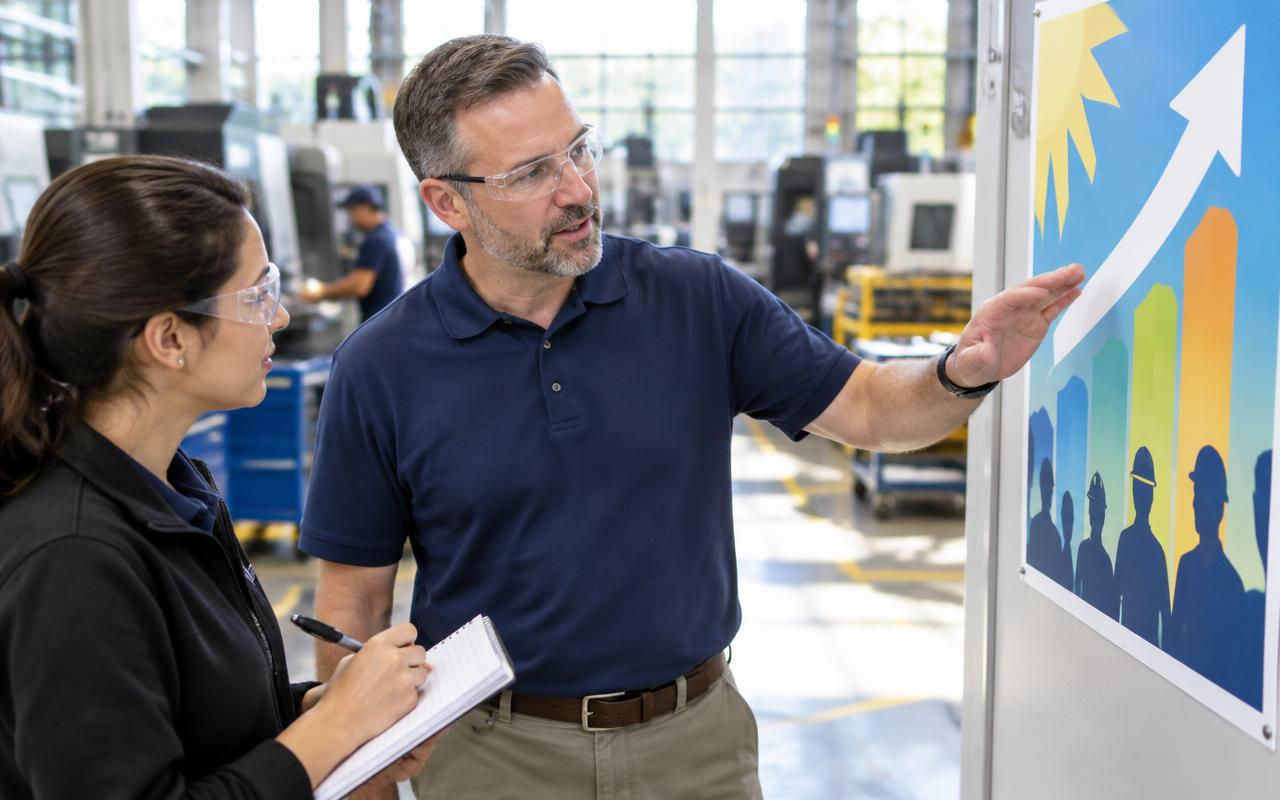
The community is also working closely with its regional workforce board and community college, both of which were included in the recruitment presentation. A slide titled READY WHEN YOU ARE featured photos of welding students, nursing students, robotics equipment and a man wearing safety glasses whose connection to the project was not immediately clear.
“We wanted to demonstrate capacity,” said Cedar Bluff Chamber President Melanie Shaw. “There are people being trained.”
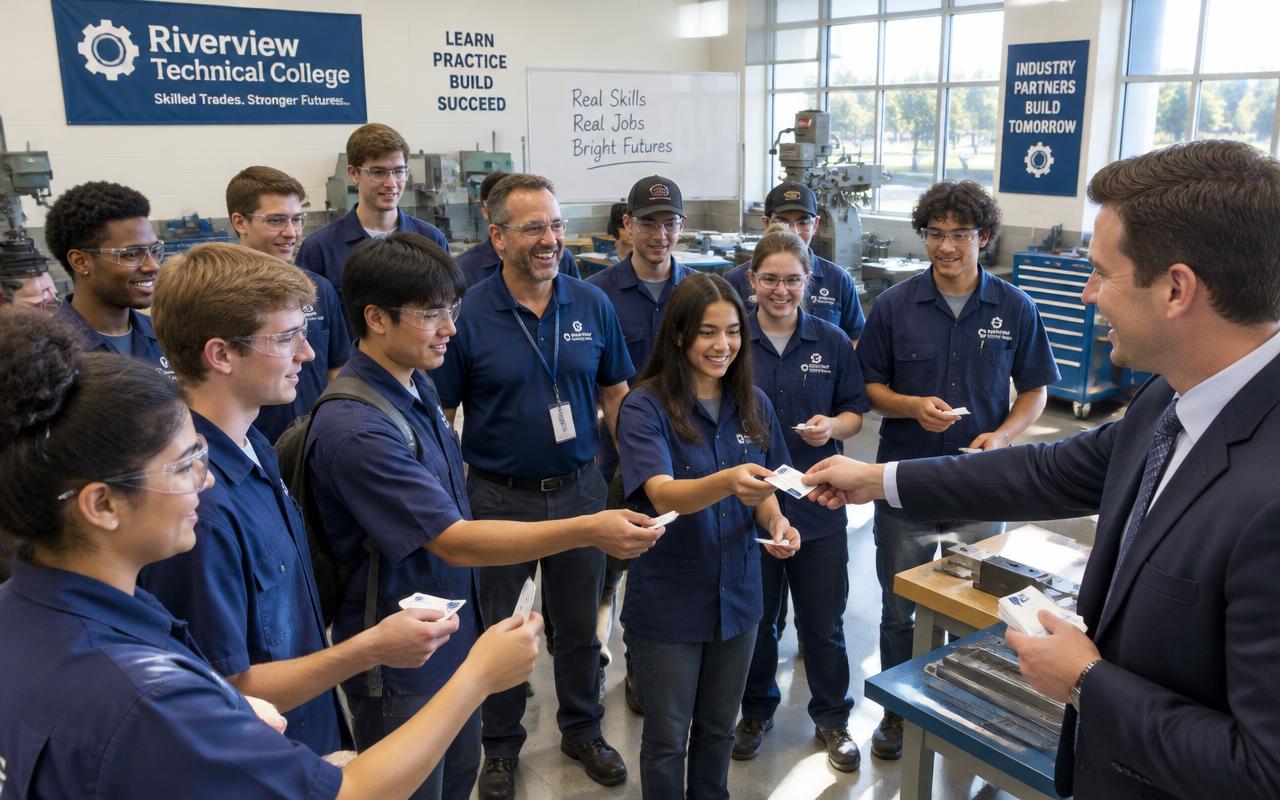
The workforce board has offered to help the company recruit and screen applicants, while the community college has indicated it can develop customized training once it knows what positions need to be filled.
Neither organization currently offers a program specific to the company’s anticipated production process, but officials said that is the point of customized training.
“It’s customized,” Shaw said.
The expanded labor shed has already been incorporated into the community’s website, proposal templates and confidential project responses. The headline now reads: ACCESS TO NEARLY 250,000 WORKERS.
A footnote explains that the figure represents the population within an “extended regional commuting area.”
The footnote is in eight-point type.
Officials said the community remains confident in its ability to staff the project and noted that workforce data should always be viewed within the broader context of regional mobility, training capacity and future population growth.
“We’re not trying to make the numbers look better,” Mercer said. “We’re trying to tell the complete story.”
At the conclusion of Tuesday’s meeting, staff discussed whether an additional county southwest of Cedar Bluff should be added to the labor shed before the next prospect presentation.
It would increase the available workforce to 301,000.
The county is 94 miles away.
Mercer said the team is still reviewing the data.
“We don’t want to get carried away,” he said.