Economic Development Director Nathan Ellis offered the clarification without being asked.
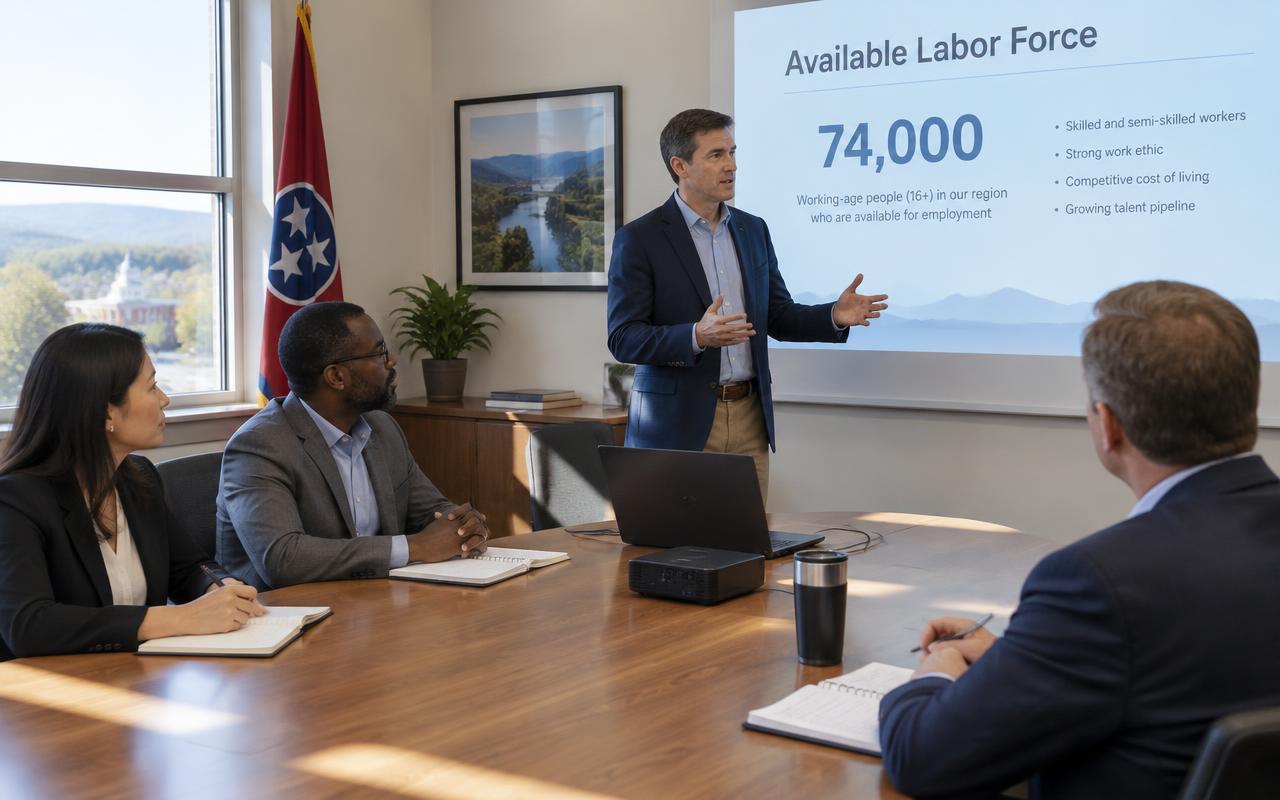
“Just so everybody knows, these are working-age people,” Ellis said while advancing to Slide 14 of the community’s workforce presentation. “Actual workforce. Very defensible.”
The prospect had not yet questioned the number.

According to officials, the unsolicited assurance stems from an uncomfortable meeting earlier this year in which a site selection consultant discovered that a previous labor analysis had defined the available workforce somewhat generously.
“We had a methodology issue,” Ellis acknowledged.
The earlier figure of 96,000 potential workers reportedly included employed residents, unemployed residents, underemployed residents, people living within a 60-minute commute, people who might consider a 60-minute commute, recent graduates, military spouses, several thousand retirees and approximately 1,200 individuals whose workforce status was categorized simply as “potential.”
“We were trying to tell the complete story,” Ellis said.
The complete story proved to be approximately 22,000 people too complete.
The new analysis, officials stressed, uses a significantly more disciplined methodology.
“We took the retirees out,” said Workforce Development Manager Brooke Hanley. “All of them.”
Hanley then quickly clarified that retirees who have returned to work are included.
“But appropriately.”
The distinction prompted the prospect’s human resources director to ask how many people in the region were actually unemployed and actively seeking work.
Ellis changed slides.
“This is where the underemployment story becomes really compelling.”
Officials explained that unemployment alone does not capture the full workforce opportunity because many local residents are currently employed but could potentially be attracted to a new company offering better wages, benefits, schedules or career advancement.
The manufacturer asked how many such workers existed.
“Potentially thousands,” Ellis said.
“How many thousands?”
Ellis looked toward Hanley.
Hanley looked toward the consultant.
The consultant said the number was “directionally strong.”
The presentation continued.
A later slide identified a labor shed of more than 210,000 people within commuting distance.
One company executive asked whether retirees were included in that figure.
“No,” Ellis replied immediately.
He paused.
“I’m almost certain.”
Hanley quietly opened her laptop.
Economic development officials say workforce numbers have become increasingly complicated as communities compete for projects requiring hundreds of employees.
“It’s not as simple as saying, ‘Here are 800 people sitting at home waiting for your factory,’” Hanley explained. “Those people generally do not exist.”
Instead, workforce analysis may consider commuting patterns, occupations, wages, labor force participation, turnover, graduate pipelines and workers who could potentially change jobs.
Officials said this provides prospects with a more realistic understanding of the market.
It also produces significantly more colorful maps.
Fairbrook’s latest workforce report contains nine.
One identifies where workers live.
Another shows commuting flows.
A third features several overlapping blue circles that officials described as “the talent ecosystem.”
The manufacturer spent nearly two minutes studying that map.
“What exactly am I looking at?” an executive finally asked.
“Regional reach,” Ellis said.
The prospect nodded slowly.
During lunch, discussion shifted to population growth, training programs and the local technical college.
Things were going well until one company representative casually asked how many people in Fairbrook County were over age 65.
Ellis put down his sandwich.
“That is a completely separate number.”
He emphasized that Fairbrook values its retiree population tremendously.
“They are an important part of this community,” he said. “They volunteer. They serve on boards. They support local businesses.”
“They’re just not assembling transmissions,” Hanley added.
At least not in the workforce model.
Officials also confirmed that college students are handled more carefully than in previous reports.
A 19-year-old studying nursing is no longer automatically categorized as a potential advanced manufacturing employee simply because she lives within the labor shed.
“We’ve tightened that up,” Hanley said.
High school juniors have also been removed.
“That one was probably aggressive,” Ellis admitted.
The new methodology has received praise from regional partners, who say the revised workforce figures provide a much clearer picture of labor availability.
The downside is that nearly every number has gotten smaller.
“That was difficult at first,” Ellis said. “You spend years telling people you have 96,000 workers and suddenly somebody hands you a spreadsheet that says 74,000.”
He stared quietly at the workforce report.
“But 74,000 is still a really good number.”
The prospect agreed and said it appreciated the community’s transparency.
Ellis visibly relaxed.
Before leaving, the company requested a copy of the underlying workforce methodology.
“Absolutely,” Ellis said.
He then turned toward Hanley.
“We have the final version of that, right?”
Hanley nodded.
“The one without retirees?”
“Yes.”
“The revised one?”
“Yes.”
“The revised revised one?”
A brief silence followed.
At press time, Fairbrook economic development officials had confirmed that the region’s labor force currently contains zero known retirees, with the possible exception of 317 people whose employment status is still being reviewed.