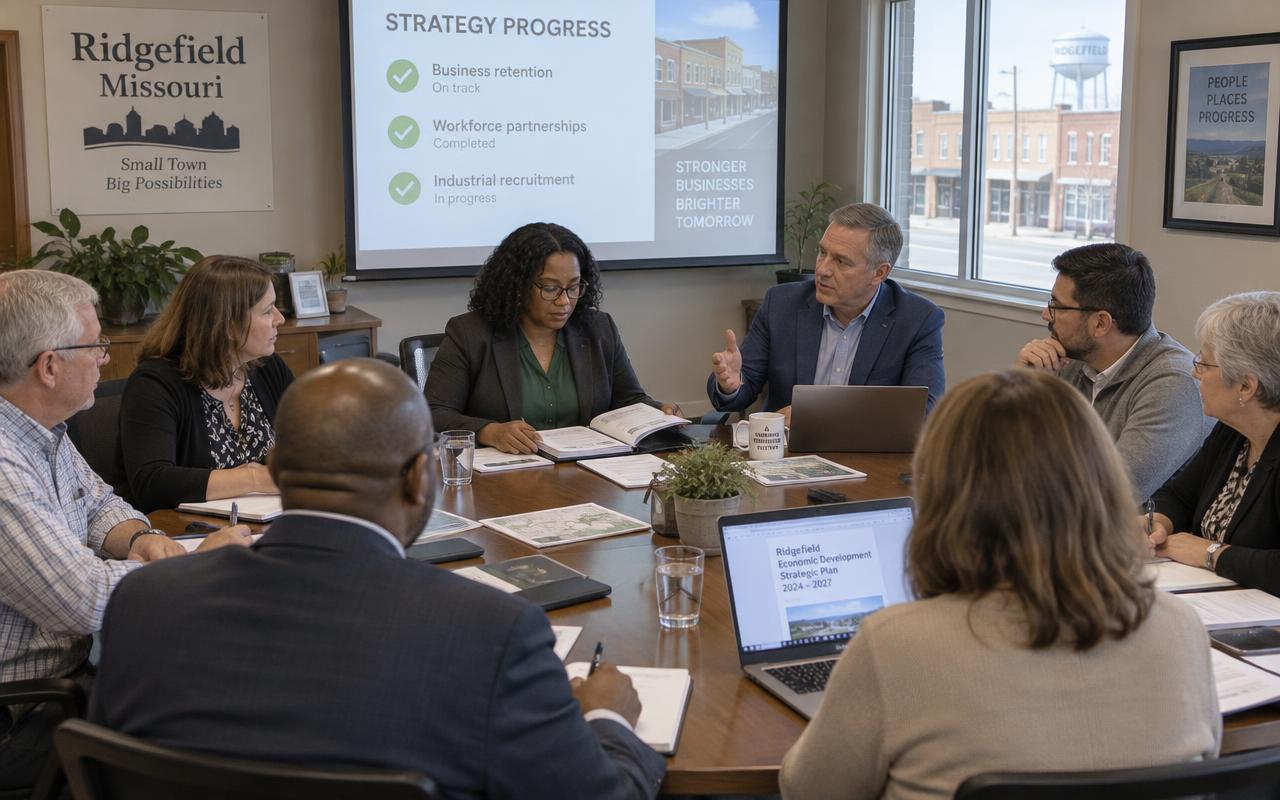
The change emerged during the organization’s monthly meeting, shortly after Price presented a detailed progress report showing that staff had completed nearly every action item assigned at the board’s strategic retreat.
“We’ve made really strong progress,” Price said.
Board members agreed.
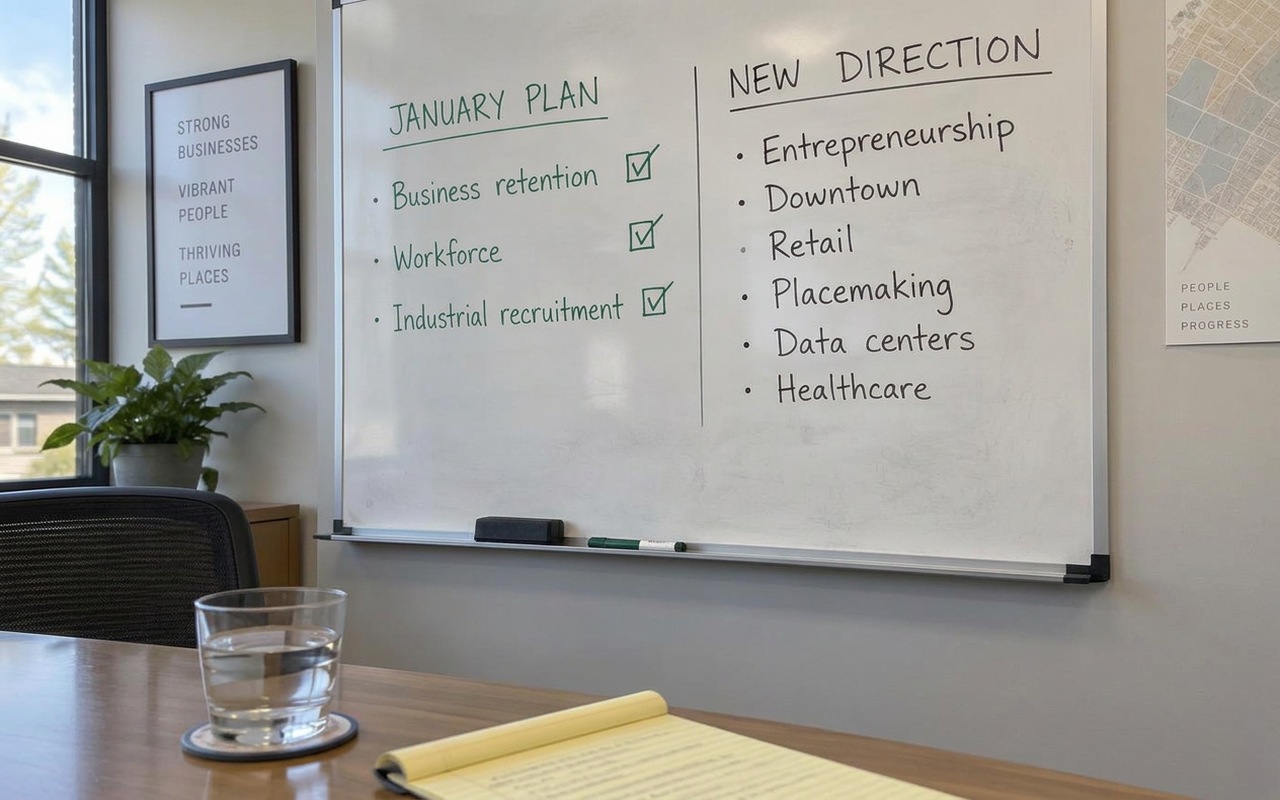
They then spent the next 90 minutes explaining why the organization should probably be doing something else.
The current strategy, approved in January, directs staff to focus heavily on business retention, workforce partnerships and industrial recruitment.
Price responded by launching an existing-industry visitation program, creating a workforce task force and developing a targeted recruitment campaign around three priority sectors.
“That was exactly what we asked for,” said Board Chair David Collins.
He paused.
“But I’m wondering if we’re maybe too focused on those things.”
Price looked briefly toward the strategic plan sitting in front of her.
Board members said they had recently become concerned that the organization was not doing enough around entrepreneurship, downtown development and retail recruitment.
None of those areas appear among the plan’s top five priorities.
“That doesn’t mean they aren’t important,” Collins said.
Price agreed.
She then reminded the board that they had specifically removed retail recruitment from the previous strategy because members felt staff was becoming spread too thin.
Several board members nodded.
“That was then,” said board member Susan Keller.
January was nine months ago.
The board’s shift in direction reportedly began after Keller visited another community and saw a successful downtown incubator.
“I just think we need to be more entrepreneurial,” she said.
Another member recently attended a conference session on placemaking and now believes the organization should take a stronger role in downtown activation.
A third read an article about data centers.
“We should probably be looking at those too,” he said.
Price said she was open to adjusting priorities.
“I just want to make sure we’re clear about what moves down if something else moves up,” she said.
The room became quiet.
Collins said he did not necessarily think anything needed to move down.
“We’re really talking about adding.”
The organization has four employees.
Price asked whether the board was considering additional staffing.
Collins said staffing would be discussed during budget season.
Budget season ended last month.
The board then reviewed the industrial recruitment campaign it approved earlier in the year.
Members praised the work.
One asked why the messaging was so focused on manufacturing.
Price explained that manufacturing was one of the three sectors selected by the board.
“That makes sense,” the member said.
He then suggested healthcare.
Healthcare was removed from the target industry list during the same retreat.
Price made a note.
Later in the meeting, board members expressed concern that they were not seeing enough immediate results from the new strategy.
Price explained that business recruitment cycles can take months or years and that several active prospects remain confidential.
“We understand that,” Collins said.
He then asked whether she could provide a list of major wins expected before December.
Price said she could provide a pipeline report.
“Something more concrete would be helpful,” Collins replied.
The board also asked staff to increase visibility in the community.
Price said the organization had recently expanded social media activity, launched a quarterly newsletter and begun attending more civic events.
Several members praised the outreach.
One suggested staff might be spending too much time on communications.
“We don’t want marketing to become the work,” he said.
Price looked at the communications goal in the strategic plan.
It was listed as Priority Two.
By the end of the meeting, the board had identified seven new areas for consideration while reaffirming that staff should remain accountable to the existing strategic plan.
Price asked whether the board wanted to formally amend the plan.
Members agreed that seemed unnecessary.
“We don’t need another planning process,” Collins said. “We just need to be nimble.”
Price nodded.
The board then unanimously directed staff to prepare a revised work program for the next meeting.
The revised work program should preserve all existing initiatives, incorporate the seven new priorities and demonstrate measurable progress by year-end.
At press time, Price was reviewing her notes from January’s retreat, where the board had written “FOCUS” in large letters across the top of a flip chart.