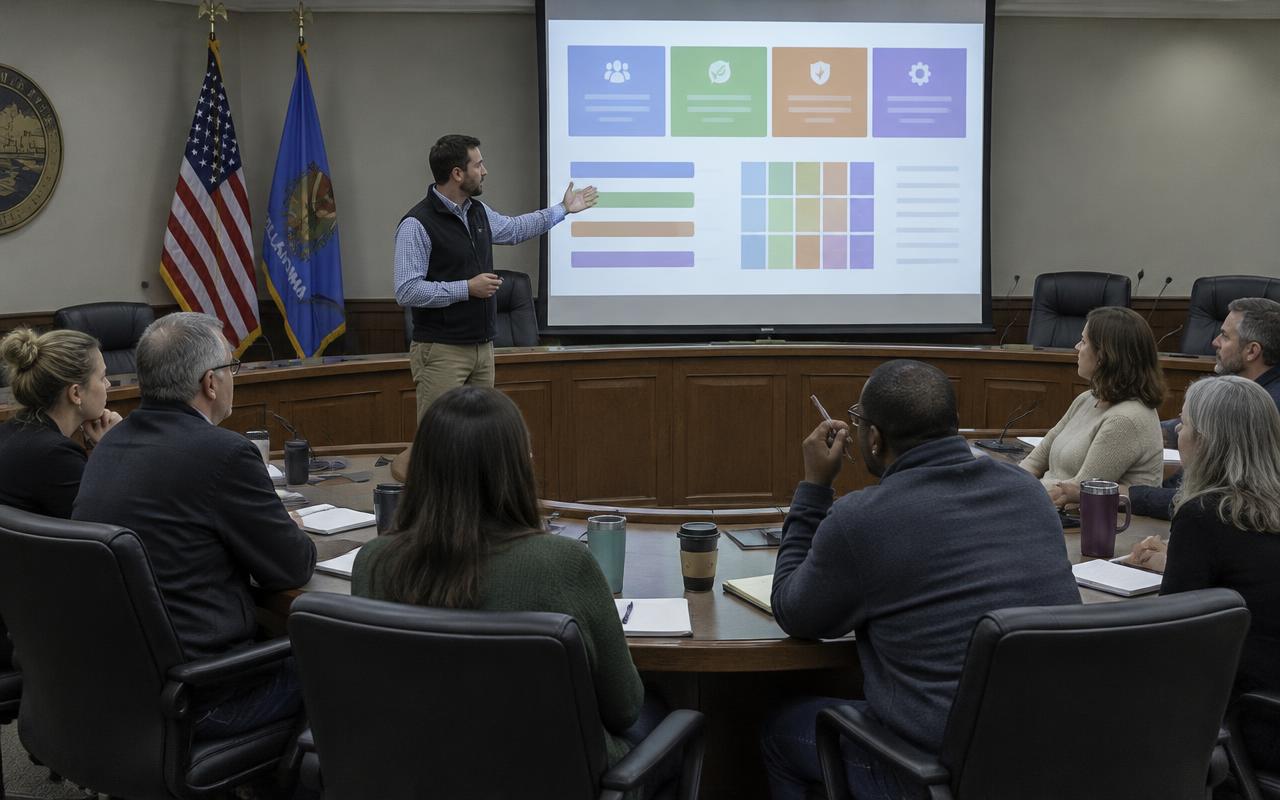

The dual policy emerged during a discussion of Bennett’s monthly director’s report, which had recently been expanded at the board’s request.
“We appreciate the thoroughness,” said Board Chair Michael Trent. “But I think sometimes we’re getting down into the weeds.”
Bennett nodded.

The report had been expanded because the board had previously asked for more detail.
Three months earlier, members said they wanted better visibility into active projects, prospect activity, business retention visits, workforce initiatives, marketing efforts, site development and partner meetings.
Bennett responded by adding those sections.
“We just don’t want surprises,” Trent said at the time.
The new report successfully eliminated surprises.
It also created 38 pages.
“That may be more visibility than we need,” said board member Karen Holt.
Bennett asked what level of detail would be most useful.
“High level,” Holt said.
Another board member immediately added that he still wanted specifics.
“Especially on projects.”
Most active projects are confidential.
The board agreed confidentiality was important.
Members then asked for more information about the confidential projects.
Bennett explained that she could provide general updates without disclosing company names or sensitive details.
“That works,” Trent said.
He then asked which companies were involved.
Bennett reminded him that the projects were confidential.
“Right, right,” Trent said. “Just keep us informed.”
The communication challenge has become particularly acute as the organization’s project pipeline has grown.
Bennett currently manages nine active prospects, six existing-industry expansion conversations, two site development initiatives and several workforce and marketing projects.
The board has asked to receive regular updates on all of them.
Preferably briefly.
“But with context,” Holt said.
Board members said they do not want long emails.
They also do not want short emails that leave out important information.
One member suggested bullet points.
Another said bullet points can oversimplify things.
A third said he mostly reads the subject line.
“We need to find the right balance,” Trent said.
Bennett has experimented with several formats.
A weekly one-page summary was considered too frequent.
A monthly detailed report was considered too long.
A quarterly strategic update was considered not frequent enough.
An executive dashboard was praised for being concise but criticized for lacking explanation.
A narrative memo provided explanation but was described as “a lot to get through.”
“We’re close,” Bennett said.
The board’s expectations also vary by project.
For routine matters, members prefer staff to handle things independently.
For important matters, they want advance notice.
Exactly when a routine matter becomes important has not been defined.
“We trust Laura to use her judgment,” said board member Steven Cross.
Cross later expressed concern that Bennett had not informed the board earlier about an issue she had judged to be routine.
“I just would have liked a heads-up,” he said.
Bennett said she understood.
She now sends more heads-ups.
Several members recently asked whether every minor development required an email.
“It’s starting to feel like a lot,” Holt said.
The board has also encouraged Bennett to call members directly when something significant happens.
Bennett asked whether she should call all seven members individually.
“Probably not,” Trent said.
Asked which members she should call, he said that depended on the issue.
The board has not adopted a formal communication protocol because members do not want to create unnecessary bureaucracy.
Instead, Bennett has developed an informal system involving emails, text messages, monthly reports, verbal updates, dashboards and an increasingly sophisticated understanding of which board members prefer which form of communication.
One member does not like attachments.
Another does not like long emails.
One prefers phone calls.
Another specifically requested not to be called during the day.
Two say they want everything.
One rarely responds.
“I’ve become very good at audience segmentation,” Bennett said.
At Tuesday’s meeting, the board ultimately agreed that staff communication was strong overall.
Members thanked Bennett for keeping them informed and encouraged her to continue providing timely updates.
They also asked her to streamline the monthly report.
“Maybe cut some of the detail,” Trent said.
Bennett agreed.
As the meeting adjourned, one board member stopped her in the hallway.
“By the way,” he said, “I didn’t see anything in the report about that company you mentioned last month.”
Bennett explained that the project had not changed.
“Okay,” he said. “Just make sure we’re kept in the loop.”
At press time, Bennett was preparing a shorter version of the monthly report with an appendix containing all the details the board had asked her to remove.